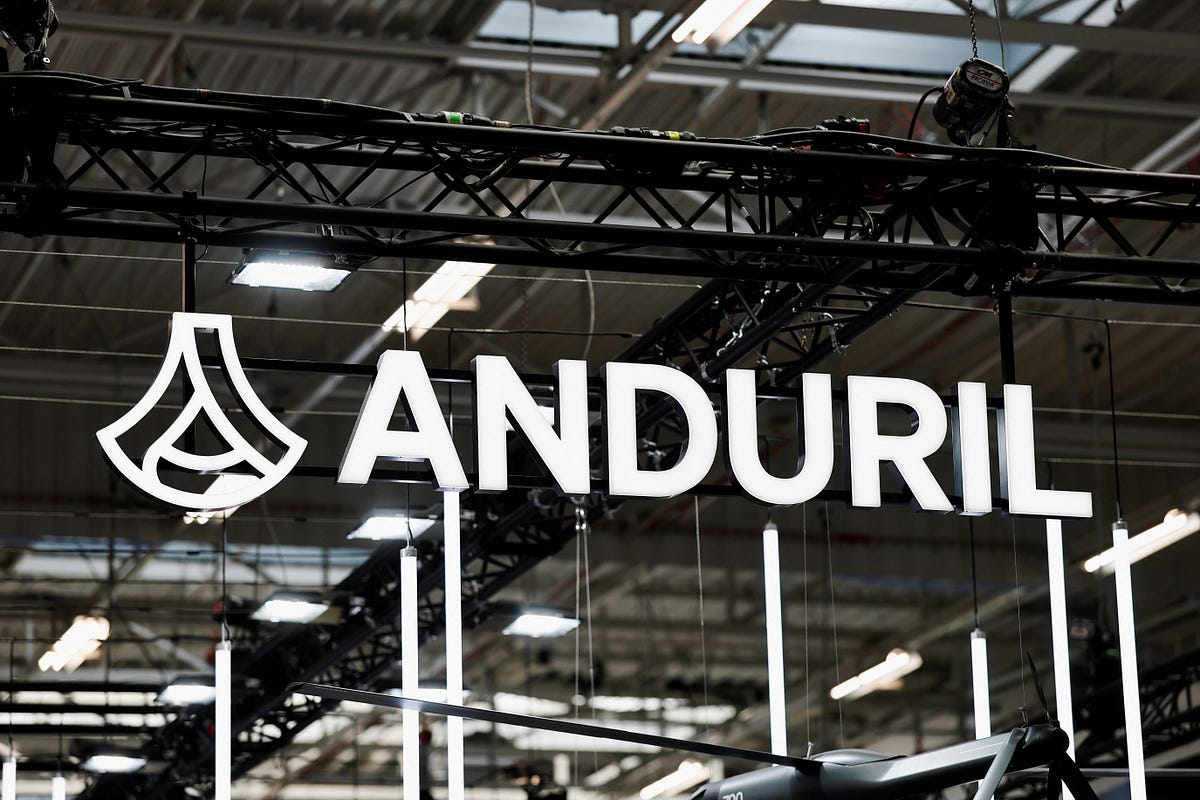
How a Boy from Long Beach Built the Future of War


Prologue: The Sword Is Named

In J.R.R. Tolkien’s The Lord of the Rings, Andúril is the reforged sword of Aragorn — a blade shattered and restored, ancient in origin but renewed for a world on the brink of catastrophe. Its name in the Elvish tongue of Quenya means Flame of the West.

It is fitting, then, that Palmer Luckey chose this name for his company. Because like that sword, Anduril Industries was forged from pieces of a broken past, hammered into something new in the fire of ambition — and aimed squarely at reshaping how America fights its wars.


Part One: The Boy Who Built Everything

Palmer Freeman Luckey was born on September 19, 1992, in Long Beach, California — not into wealth or privilege, but into curiosity. His father sold cars. His mother homeschooled him. And from an early age, Luckey tinkered with things that could kill him.

As a child and teenager, he built railguns in his bedroom, Tesla coils in the garage, and laser systems that left him with scars. He was not reckless — he was relentless. The distinction mattered. Where most kids played games, Luckey reverse-engineered them. He built a six-monitor PC gaming rig worth tens of thousands of dollars. He founded an online forum called ModRetro, dedicated to the obscure hobby of turning old hardware into portable devices. He taught himself electrical engineering not from a classroom but from necessity, from obsession.

While still a college student, Luckey landed a part-time engineering role at the University of Southern California’s Institute for Creative Technologies, where he worked on virtual reality systems to help veterans suffering from PTSD. The project was called BRAVEMIND. It was there — in a lab dedicated to healing the psychological wounds of war — that Luckey first encountered the strange intersection of technology and national security that would define his life.

But before the Pentagon, there was the headset.


Part Two: The Rift and the Windfall

In 2012, at nineteen years old, Palmer Luckey was living in a camper trailer and building a virtual reality headset prototype that most engineers in the industry had dismissed as impossible — not technically, but commercially. The consumer market for VR had collapsed in the 1990s, and no one in Silicon Valley was eager to revisit it.

Luckey didn’t care. He was building it anyway.

The device he created was the Oculus Rift, and it worked. It was rough, janky, and made people sick if they wore it too long — but it worked in a way that nothing else had. Game developers who tried the prototype came away believing that virtual reality was not a gimmick but a medium. Luckey launched a Kickstarter campaign and raised $2.4 million. Then Doom creator John Carmack showed up at E3 with a hacked-together Rift demo and the gaming world lost its mind.

By 2014, Oculus VR had raised venture capital, attracted the best engineers in the field, and built a technology that Mark Zuckerberg decided he could not ignore. Facebook acquired Oculus VR for $2 billion. Palmer Luckey was twenty-one years old.

He became, almost overnight, one of the richest young inventors in American history. He was featured on Forbes’ list of America’s Richest Entrepreneurs Under 40. He was called “the face of virtual reality.” He wore Hawaiian shirts to industry conferences, went barefoot, and seemed to regard the whole spectacle of Silicon Valley celebrity with cheerful bemusement.

But within Facebook’s walls, things were different.


Part Three: The Firing, the Phone Call, and the Plan

In September 2016, it was reported that Luckey had donated $10,000 to a pro-Donald Trump political organization. The backlash inside Facebook — and across Silicon Valley — was swift and ferocious. In March 2017, Luckey was gone. Facebook denied his politics had anything to do with his departure. Luckey, years later, said simply: “I gave $9,000 to a political group that was for Donald Trump and against Hillary Clinton.”

Whatever the cause, the effect was the same. At twenty-four, Palmer Luckey was fired from the company that had bought his dream, left with a $2 billion fortune, no job, and no plan.

He made a phone call.

The man on the other end was Trae Stephens — a venture capitalist at Founders Fund who had met Luckey at a retreat on Sonora Island, British Columbia, in the summer of 2014. The two had bonded over an unlikely shared obsession: the idea that Silicon Valley had abandoned the national security sector, leaving the American military dependent on slow, expensive, and increasingly obsolete technology.

Stephens had spent years trying to find or fund a defense startup bold enough to challenge Lockheed Martin, Raytheon, and the rest of the Pentagon’s legacy contractors. He had failed. The problem wasn’t money — it was founders. Almost no one in the tech world wanted anything to do with the Department of Defense.

“He called me,” Stephens later recounted, “and he’s like, ‘Well, Zuck’s going to fire me. Maybe we should revisit this Stark Industries idea.’”

They would not be building a suit of iron armor. But the idea — of a small team of engineers, armed with commercial technology and Silicon Valley speed, building weapons that could match or outpace state adversaries — was very much the same.


Part Four: Building the Flame

In June 2017, Anduril Industries was incorporated.

The founding team was small but formidable. Beyond Luckey and Stephens, they recruited Brian Schimpf — the Director of Engineering at Palantir Technologies, one of the most sophisticated data and intelligence companies in the world. Schimpf would become CEO. They added Matt Grimm, also from Palantir, as COO — described by Stephens as the most effective person he had ever seen at scaling an early-stage company. And they brought in Joseph Chen, an early Oculus hardware lead who had also served as a paratrooper — a man who understood both circuits and combat.

They named the company after Aragorn’s sword. The initials — AI — were not accidental.

Luckey’s thesis was blunt: “The defense industry has been stagnant for decades.” The big contractors had no incentive to innovate. They were paid on cost-plus contracts — the more they spent, the more they earned. They built systems that took fifteen years to procure and cost ten times what commercial equivalents would. They hired armies of lobbyists instead of engineers.

Anduril would do the opposite. It would build like a tech startup — fast, iterative, software-first — and sell finished products to the government rather than billing by the hour. It would own its intellectual property. It would move at the speed of the commercial market, not the Pentagon’s procurement calendar.

The weapon it would wield was artificial intelligence.


Part Five: Lattice and the Autonomous Edge

Anduril’s first product was not a gun or a missile. It was software.

The platform was called Lattice OS — an artificial intelligence command-and-control system designed to fuse data from dozens of sensors, cameras, radar arrays, and satellite feeds into a single, real-time picture of a battlefield or border. Lattice didn’t just collect data. It interpreted it. Using machine learning and computer vision, it could identify humans, vehicles, and aircraft, track their movements, and surface actionable intelligence to operators — faster than any human analyst could.

To demonstrate what Lattice could do, Luckey pitched it to the Department of Homeland Security as a border security solution. The pitch worked. In 2018, Anduril deployed autonomous surveillance towers along the U.S.-Mexico border, equipped with long-range cameras, radar, and AI processing. In their first weeks of operation, the towers helped border agents apprehend 55 individuals and intercept nearly 1,000 pounds of marijuana in Texas alone. The towers were not armed. They did not fire. They watched, and they learned, and they told humans what they saw.

It was a proof of concept. Anduril was showing the Pentagon what autonomous systems could do — not in theory, not in a lab, but in the field.

The contracts followed.


Part Six: The Machines of War

What distinguished Anduril from every other defense contractor was not just that it used AI. It was how it used AI — not as a layer of automation grafted onto legacy platforms, but as the fundamental architecture around which everything was built.

The hardware that emerged from Anduril’s labs was unlike anything the traditional defense industry had produced.

Ghost — an autonomous drone designed for endurance surveillance — used Nvidia processors originally developed for self-driving cars to handle all onboard computation locally, without relying on a communication link to a central server. This allowed it to operate in radio silence, immune to jamming. Its camera could image objects in high resolution at over 2,500 feet. Its five modular payload bays could be reconfigured in minutes — surveillance cameras, laser designators, electronic warfare systems, or even kinetic weapons. Multiple Ghost drones could link together in coordinated swarms, sharing data across a mesh network, extending their collective range and intelligence far beyond any single unit.

Roadrunner — a vertical-takeoff interceptor — was designed to autonomously hunt and destroy enemy drones and missiles, operating as a reusable loitering munition that could be recalled if its target was misidentified. It represented something genuinely new in warfare: an autonomous weapon that could choose not to fire.

Fury — an autonomous fighter jet — pushed the concept even further. Where Ghost and Roadrunner supported human operators, Fury was designed to fly, fight, and survive in contested airspace without a pilot aboard. It was Anduril’s most radical bet: that the future of air combat would not be defined by manned aircraft but by machines that could think and react faster than any human could.

The connective tissue of all these systems was Lattice. Every drone, every sensor, every tower fed into the same AI brain. The battlefield became not a collection of isolated platforms but a networked, intelligent organism — watching, calculating, and acting.


Part Seven: Arsenal of Democracy, Rebuilt

By 2022, Anduril had won a $1 billion contract with the United States Special Operations Command to lead counter-drone work. By 2023, its systems were being used in Ukraine, where Anduril-supplied drones were striking high-value Russian targets. The war in Ukraine — the first major conflict in which autonomous systems played a decisive role — validated everything Luckey had argued about the future of warfare.

The investment world noticed. In December 2022, Anduril closed a $1.48 billion Series E funding round, valuing the company at $8.48 billion. Only SpaceX and Epic Games raised more money in the same period. By 2024, Anduril’s valuation had climbed to $14 billion, then $30 billion. In early 2026, the company was in talks to raise as much as $8 billion in new funding at a valuation of at least $60 billion.

In January 2025, Anduril announced the Arsenal Project — a series of hyperscale manufacturing facilities designed to produce autonomous weapons systems at industrial scale. The first facility, Arsenal-1, is under construction near Columbus, Ohio, in partnership with Ohio State University. It is not a factory in the traditional sense. It is a place where machines will build machines.

Luckey’s vision had always been this: not a company that sold weapons to the government, but a company that industrialized autonomy — that made it possible to produce AI-enabled defense systems faster than America’s adversaries could respond.


Epilogue: The Flame Burns West

Palmer Luckey is thirty-three years old. He goes barefoot to trade shows. His wife sews historically accurate Renaissance costumes. He has experimented with vestibular implants to pipe audio directly into his skull. He has a bypass installed in his peripheral nervous system to experiment with superhuman reflexes. He is, by any measure, a strange man.

He is also, by any measure, one of the most consequential figures in American defense since the Cold War.

What he understood — what the legacy contractors and the Pentagon bureaucracy had failed to grasp — was that the age of platforms was ending. The age of software had arrived. A missile guided by GPS and flown by a pilot in Nevada was already obsolete before it launched. The future belonged to systems that could think for themselves, adapt in real time, operate in swarms, and overwhelm an adversary through volume, speed, and intelligence rather than raw destructive power.

Anduril was not a defense company that happened to use AI. It was an AI company that happened to be defending a nation.

The sword had been reforged. The flame burned west.


Anduril Industries is headquartered in Costa Mesa, California. As of 2026, the company employs thousands of engineers, operators, and veterans across its campuses and is actively building its first autonomous weapons manufacturing facility in Ohio. Palmer Luckey serves as its founder and Chief Technology Officer. Brian Schimpf serves as CEO.


Leave a Reply

Your email address will not be published. Required fields are marked *
