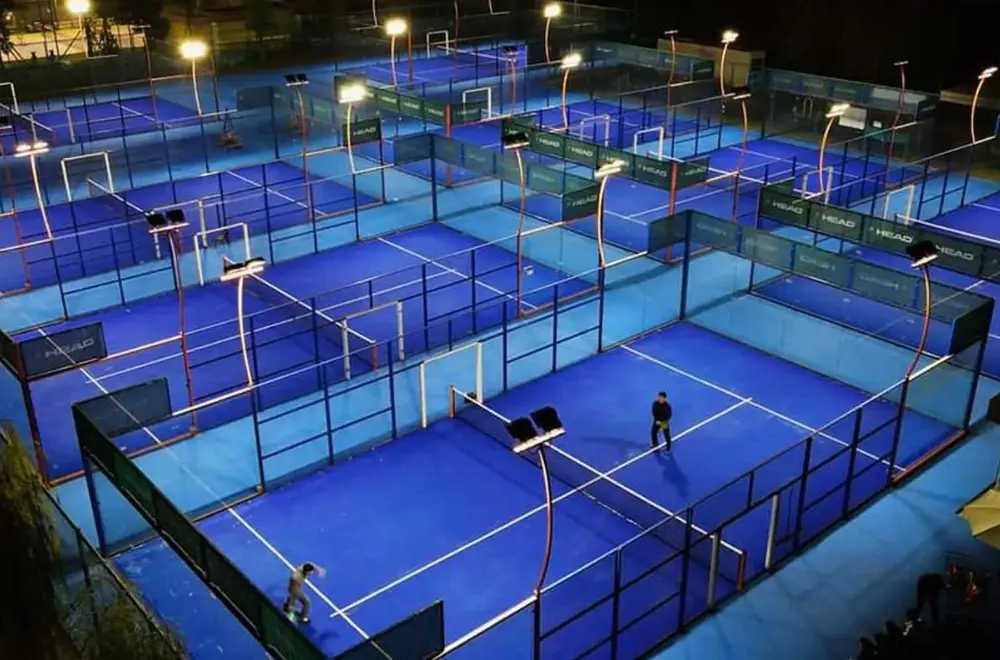
A sport born in a Mexican backyard is quietly reshaping the American sports landscape — one glass wall at a time.
A Stranger in a Strange Land
Not long ago, most Americans had never heard of padel. If they had, they probably confused it with pickleball, paddle tennis, or some vague European cousin of racquetball. Today, the sport is the subject of breathless investment pitches, celebrity Instagram posts, and packed courts from Miami to Manhattan. In 2019, the United States could claim fewer than 20 padel courts. By early 2025, that number had exploded past 650 across 31 states — and the construction crews haven’t stopped.
Padel (pronounced either “paddle” or “puh-DELL,” depending on who you ask) is a doubles racquet sport played on an enclosed court roughly a quarter the size of a tennis court. Glass walls and metal mesh fencing form the boundaries, and the ball can be played off any surface — turning what looks like a simple rally into a three-dimensional chess match. The racquet is solid like a pickleball paddle but heavier, riddled with small air holes, and satisfying in a way that’s hard to describe until you’ve held one. Scoring mirrors tennis, but the geometry of the game is entirely its own.
It was invented in 1969 by Mexican businessman Enrique Corcuera, who wanted to build a tennis court on his property in Acapulco but didn’t have quite enough room. He improvised with walls. His neighbor, Alfonso de Hohenlohe, brought the idea to Marbella, Spain — and from there, padel conquered an entire continent. Spain now considers it the country’s second-most popular participation sport, behind only football. Sweden, Argentina, Brazil — all have been swept up in the game for years. America, characteristically, arrived a little late. But when it arrives, America tends to arrive loudly.
The Numbers Don’t Lie
The statistics behind padel’s American ascent read like a venture capital fever dream. Player participation in the U.S. jumped by 250 percent between 2022 and 2024. By mid-2025, roughly 112,000 Americans were playing regularly, with amateur participation passing 100,000 early in the year. The U.S. Padel Association, which counted just 163 members in 2020, had grown its membership to nearly 1,917 by 2024, with licensed professionals approaching the 2,000 mark by 2025.
Court infrastructure is racing to keep up. More than half of the courts operating in mid-2025 were installed after January 2024 alone — a construction wave that makes the sport feel less like a slow burn and more like a detonation. A comprehensive industry report, the “State of Padel in the U.S. Report 2025,” authored by strategic consultant Patricio Misitrano, declared the sport has reached “irreversible momentum” and described the window to lead as “open now.” Projections from the U.S. Padel Association suggest the country could have 30,000 courts and 10 million players by 2030.
Even those rosier forecasts come with a significant caveat: the infrastructure gap is enormous. The U.S. currently has roughly one padel court for every 505,000 people. Spain, where the sport is woven into daily life, has one court for roughly every 3,000 people. Sweden has one per 2,000. America is not catching up so much as it is just beginning to realize the scale of the mountain.
Florida, Texas, and the Coastal Surge
Geography has shaped padel’s American story as much as demographics. Florida is home to roughly 41 percent of all padel courts in the country, with the Miami–Fort Lauderdale metro functioning as something close to the sport’s American capital. The warm climate makes outdoor courts viable year-round, and South Florida’s large Latin American population — many of whom grew up watching or playing padel — provided an early, enthusiastic base. Texas follows with about 18 percent of national courts, California with 10 percent, and New York with under 5 percent.
But the geography is shifting. The more recent wave of court openings is distinctly indoor and distinctly northern. New York, Boston, and New Jersey have all seen new clubs open in 2024 and 2025, as have Chicago, Detroit, Dallas, Houston, and Austin. Indoor courts now represent nearly 40 percent of all U.S. padel facilities — a figure that was negligible just two years ago. The move indoors is strategic: it eliminates seasonality, enables consistent lighting, and supports the premium membership pricing that makes the business model work in expensive urban real estate markets.
Search trend data tells its own story. Across 2025, Americans Googled “padel near me” and “what is padel” at surging rates, with Florida, New York, Texas, Virginia, and California leading by search volume. Specific clubs — Padel Haus, Reserve, Ultra Padel — are becoming brand names. Virginia, Arizona, and Connecticut emerged as surprising growth markets, suggesting the sport is spreading well beyond its coastal footholds.
Stars, Money, and the Pro Game
No sport scales in America without celebrity oxygen, and padel has been breathing it in. A roster of globally recognizable names has embraced the game: Lionel Messi, Rafael Nadal, Serena Williams, Eva Longoria, Adam Levine, Jimmy Butler, Drew Brees, Daddy Yankee, and Formula 1 champion Max Verstappen have all been associated with the sport in some capacity — as players, investors, or enthusiastic evangelists. Their involvement has done what celebrity involvement always does: it signals to potential players and investors alike that this is something worth paying attention to.
On the professional side, the Pro Padel League (PPL) has established itself as the dominant team competition in North America. Its 2025 season marked a significant milestone, staging events internationally in Mexico and Spain for the first time and partnering with court manufacturer AFP Courts to debut an innovation called DarkGlow NV — a photoluminescent surface designed to improve player visibility and enhance the visual experience for broadcast audiences. The PPL has confirmed its expanded schedule for 2026, and AFP Courts has announced plans to deepen its nationwide presence and its partnership with the U.S. Padel Association.
Global professional tours also made a high-profile American statement. Premier Padel, one of the sport’s top international circuits, brought a tournament to Miami in 2025 — a signal to both the sport’s faithful and its potential converts that the U.S. is now a market worth courting at the highest level.
Equipment spending is another proxy for genuine interest, and the numbers are striking. The total U.S. market for padel gear reached an estimated $10 million in 2024, with leading brands projecting year-over-year growth of 70 percent or more in 2025. RacquetX, a racquet sports trade show held in Miami, has become a gathering point for international padel brands staking claims in the American market. Adidas, Head, Babolat, Wilson, and Bullpadel are all competing for shelf space in a country where the sport barely existed a decade ago.
The Pickleball Question
No conversation about padel in America proceeds for long without someone raising pickleball. The comparison is inevitable and, depending on who you ask, either helpful or deeply annoying.
Pickleball is currently the fastest-growing sport in the United States by sheer number of players, a juggernaut of suburban courts and retirement communities that has made racquet sports culturally visible in a way they haven’t been in decades. Padel is frequently described as the more athletic, more complex, and — whisper it — more sophisticated sibling. Pickleball players themselves have been among the most enthusiastic adopters of padel, seeing it as a natural progression.
The two sports are increasingly coexisting rather than competing. About 30 percent of U.S. pickleball venues now offer padel courts — a significant shift from just a year prior. Even the U.S. Tennis Association’s campus in Florida, home to the sport that once ruled every racquet conversation, has added padel courts alongside its tennis and pickleball facilities.
The padel community has learned, perhaps from watching pickleball’s rapid rise and occasional growing pains, to emphasize what makes the sport distinct: the walls that turn defense into attack, the rallies that run longer and reward intelligence over raw power, the inherently social four-person format that makes the game feel more like an event than a workout.
The Obstacles Are Real
For all its momentum, padel’s path in America runs through a series of genuine obstacles that no amount of celebrity endorsement makes disappear.
Space is the first. Padel courts, while smaller than tennis courts, must be enclosed in glass and metal — structures that require proper planning approval and construction permitting. The acoustic signature of the game, that distinctive crack of ball against glass, has complicated approvals in residential and mixed-use neighborhoods. Many U.S. developers who expected to open clubs within six to twelve months found themselves navigating permitting timelines stretching to two or three years.
Cost is the second. Indoor court installations run significantly higher than outdoor equivalents — a 45 percent premium, by some estimates. Premium urban real estate makes the economics even more challenging. The super-club model — purpose-built facilities with eight to twelve courts, locker rooms, restaurants, and social spaces — works financially in dense, affluent markets, but it’s not easily replicated in smaller cities.
Awareness remains the third. As recently as 2025, one of the most common padel-related Google searches in the United States was simply “what is padel.” The sport is still explaining itself to the majority of the American public. Building the infrastructure of instruction — certified coaches, beginner programs, school partnerships — is work that takes time and investment, and it is only now getting seriously underway.
The Window Is Open
Padel’s advocates are not confused about what moment this is. The “State of Padel in the U.S.” report put it plainly: those who invest early — in clubs, facilities, real estate, and technology — will capture leadership in what could become one of the next major breakout sports in the American market.
The return rate is one of the sport’s most remarkable statistics: 92 percent of people who try padel come back to play again. It is accessible enough for beginners, tactical enough for serious athletes, and social enough that it fills the particular hole in modern life that many forms of recreation never quite reach. The same qualities that made pickleball a phenomenon are present in padel, with added layers of complexity and physical demand that tend to sustain long-term engagement.
By 2026, projections suggest the country is entering a phase of accelerating growth — more courts, more facilities, more visibility, and the kind of normalization that comes when a sport is no longer something you have to explain to your friends. The American padel story is still in its early chapters. But the glass walls are going up, the courts are filling, and somewhere right now, in a warehouse in Brooklyn or a new complex outside Austin, someone is picking up a padel racquet for the first time.
Most of them will be back tomorrow.
Sources: Playtomic Global Padel Report 2025; U.S. Padel Association; State of Padel in the U.S. Report 2025 (Misitrano Consulting); SGB Media; The Padel Paper; Tennis Creative; Padel United Sports Club; PadelUSA.org

